

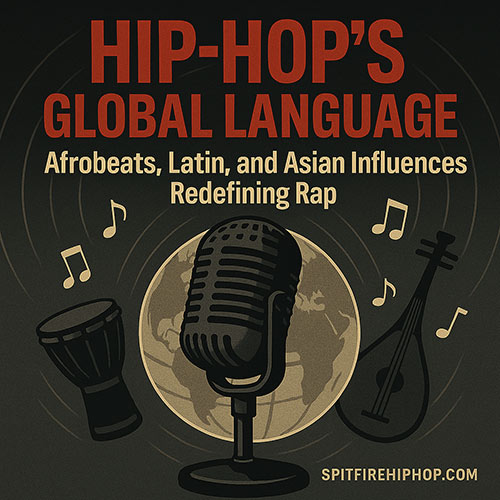
Hip-Hop has never stayed still. From the Bronx to Lagos to Seoul, the culture continues to evolve, blending regional styles, languages, and rhythms. In 2025, Hip-Hop isn’t just a genre—it’s a global language.
From Local Movement to Global Pulse
What began in block parties and boroughs has become a worldwide conversation. Today, Hip-Hop transcends geography. Artists in Nigeria, Brazil, South Korea, and France infuse their own dialects and drums into the culture, while still honoring its core values: rhythm, resistance, and storytelling.
Streaming platforms have erased borders, making it easier for sounds like Afrobeats, Latin Trap, and Asian Drill to travel at lightning speed. Collaborations that once seemed rare, say, a Brooklyn rapper trading verses with an artist from Lagos, are now a weekly occurrence.
The Afrobeats Wave: Rhythm Meets Rap
The rise of Afrobeats has been impossible to ignore. Artists like Burna Boy, Wizkid, Tems, and Rema blend percussive grooves and melodic cadences that fit naturally with rap flows. For American Hip-Hop artists, this fusion offers a refreshing rhythmic palette, with less aggression and more movement.
The synergy between Hip-Hop and Afrobeats reflects shared roots. Both genres were born from social struggle, Black expression, and sonic innovation. Their union feels like a cultural reunion rather than a crossover.
Latin Trap and Reggaeton: Global Heat
Latin Trap has transformed Hip-Hop’s party energy. Artists such as Bad Bunny, Anuel AA, and Myke Towers have rewritten what global success looks like, topping charts in both English and Spanish.
Producers are experimenting with bilingual bars, merging 808-heavy beats with Caribbean percussion, proving that rap doesn’t need translation; it needs rhythm.
For younger audiences, the blend of Latin Trap and Hip-Hop represents freedom: no language barrier, just a shared vibe. These fusions dominate TikTok challenges, club playlists, and global festivals alike.
Asian Drill and the Unexpected Innovators
In recent years, Asia has produced some of Hip-Hop’s boldest new sounds. Japanese, Korean, and Filipino artists are embracing drill and trap, infusing them with cultural instruments and tonal patterns unique to their regions.
Korean producers, for instance, are layering traditional percussion like buk drums into drill beats. Meanwhile, the Philippines’ underground scene thrives on lyrical storytelling over dark, minimal instrumentals. The result: a new wave of artists who feel deeply global yet unmistakably local.
Why Fans Embrace Global Hip-Hop
Hip-Hop’s international rise mirrors the digital generation’s values: authenticity, diversity, and accessibility. Fans no longer care where an artist is from; they care what the music feels like.
Social media and streaming collapsed the old model of cultural gatekeeping. Now, a viral freestyle from Nairobi or a drill cypher in Seoul can inspire creators in New York within hours. The audience is global, and so is the inspiration.
The Future of a Global Sound
Hip-Hop’s evolution into a global language marks a shift in power. No single region owns the narrative anymore. Every artist contributes their dialect, their rhythm, their truth.
This decentralized ecosystem ensures that Hip-Hop will continue to evolve, absorbing, adapting, and amplifying stories that matter from every corner of the world.
From Bronx block parties to Afrobeats anthems and Seoul street cyphers, Hip-Hop continues to prove that rhythm knows no borders. In 2025, the culture’s global voice is stronger than ever, loud, multilingual, and united by the beat.